
Insights
Where few want to fly
This perspective paper is published on the back of a comprehensive assessment of humanitarian air transport requirements mandated by BlueLight Humanitarian Airline and conducted by Arche Consultancy between January and May 2026. Arche Consultancy ran 16 semi-structured interviews with 11 different Humanitarian organisations.
This paper distils high-level, anonymised results and is not academic research, although the data set has been shared with an academic team.
All views expressed here are solely those of the author. The full methodology is set out in the PDF.
How humanitarian aviation works, and how it is bought
Humanitarian aviation splits into two largely independent markets: cargo and passengers.
They are served by different vendors, through different onboarding and contracting processes, using different aircraft types, against different vendor requirements.
Passengers
Already partially consolidated, with a single mandated agency purchasing on behalf of all other United Nations entities.
Passenger demand can be forecast and is relatively stable. Organisations contract small aircraft to be positioned in one country for a long period, typically two to four years, and to operate from there. The contract type is mainly ACMI, for aircraft, crew, maintenance and insurance. Insurance is paramount and is often cited as a non-negotiable.
These operations rely on small turboprop aircraft such as the Cessna Caravan and the LET-410, valued for their short take-off and landing capability. They are suited to the short, often unpaved airstrips typical of last-mile humanitarian destinations.
Becoming an approved vendor is a lengthy process, generally six to twelve months, centred on safety audits and alignment with UN aviation standards. This long onboarding process, combined with multi-year contracts, means organisations tend to stay with the same small group of vendors once a relationship is established. On the market, around a dozen specialised operators serve humanitarian passenger needs, but in the highest-risk and hardest-to-reach locations that pool narrows further, with few operators willing to accept the risk.
Cargo
The more fragmented of the two, with purchasing strategies that range from spot purchase to long-term agreements with freight forwarders.
While passenger air transport is concentrated around few buyers and few vendors, many more organisations purchase cargo airfreight, and through different channels: air operators, brokers and freight forwarders.<
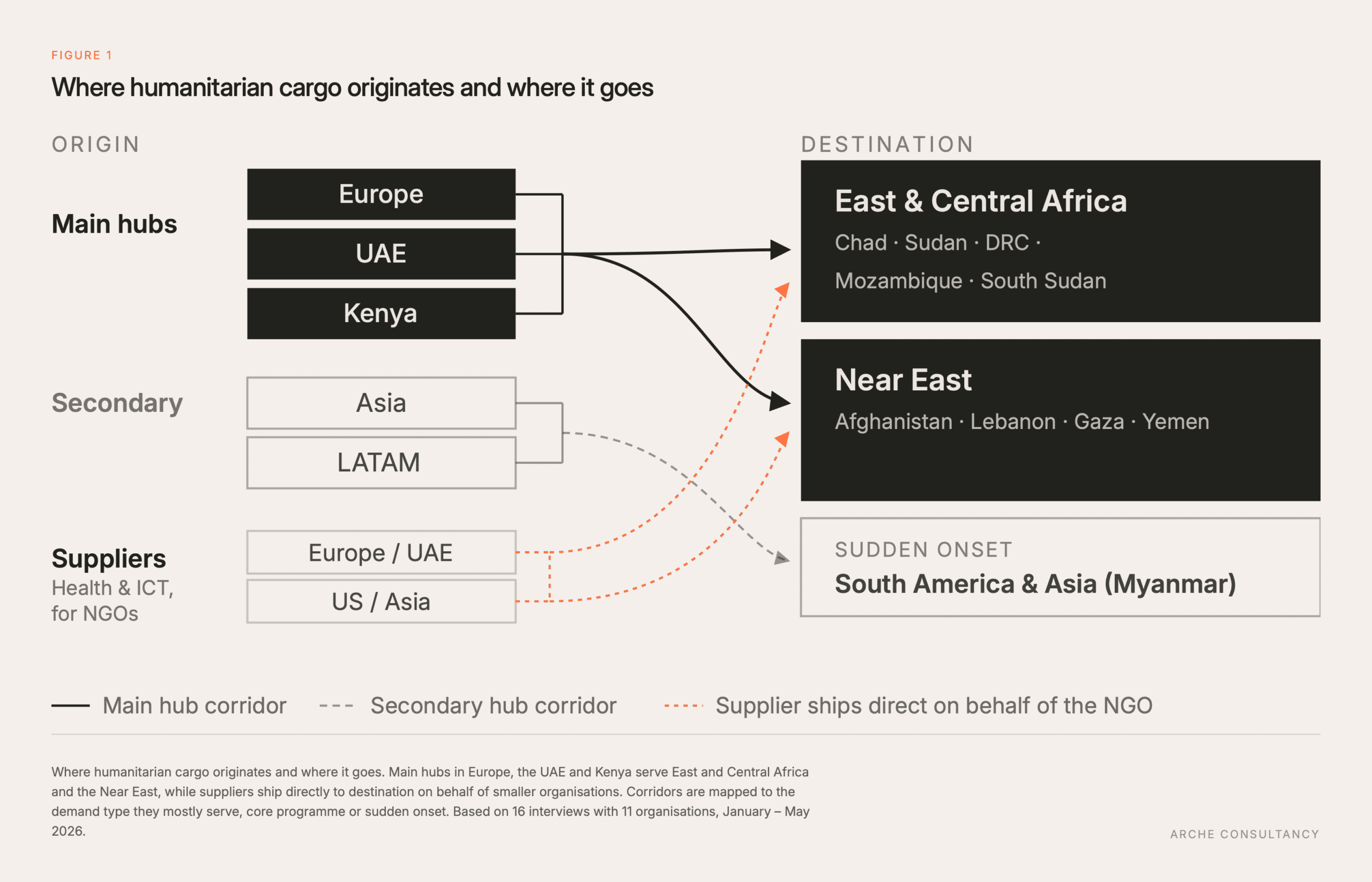
Cargo demand falls into three categories:
- Recurrent demand linked to core programmes. Volumes are relatively stable and forecastable, derived from the core programmes of the organisation, such as a recurring vaccination campaign.
- Protracted emergency. Beyond the initial three to six months after a disaster, air transport can become a regular and forecastable requirement, especially where alternative modes of transport are either unavailable or too costly.
- Sudden-onset surge. During a sudden-onset emergency the first response is usually by air, where a large volume of items needs to be shipped rapidly, usually from warehouse hubs to the disaster zone.
Full charter cargo operations are flown mainly on wide-body freighters (60 to 120 tonnes), chosen to capture economies of scale. Typical aircraft cited are the Boeing 747 and 777.
Of the eleven organisations interviewed, six rely on long-term freight-forwarder agreements, two purchase only on the spot market, two do not purchase airfreight directly, and one runs a dual strategy.
Why Organizations often rely on freight forwarders:
01 - Multimodal reach
A freight forwarder can handle complex multimodal requirements, as well as advising on import and export requirements, which are mainly a constraint for NGOs.
02 - Technical depth
The freight forwarder brings strong capability for sensitive products such as dangerous goods or temperature-sensitive items, and is the sole party responsible for the integrity of the supply chain end to end.
03 - Sector fluency
The freight forwarder offers a deep understanding of humanitarian ways of working, with dedicated teams.
On the other side, the interest of a spot purchase lies in broader competition and in a potentially faster turnaround, as the organisation contracts the air operator directly and cuts out one intermediary.
What are the main pain points for Humanitarians
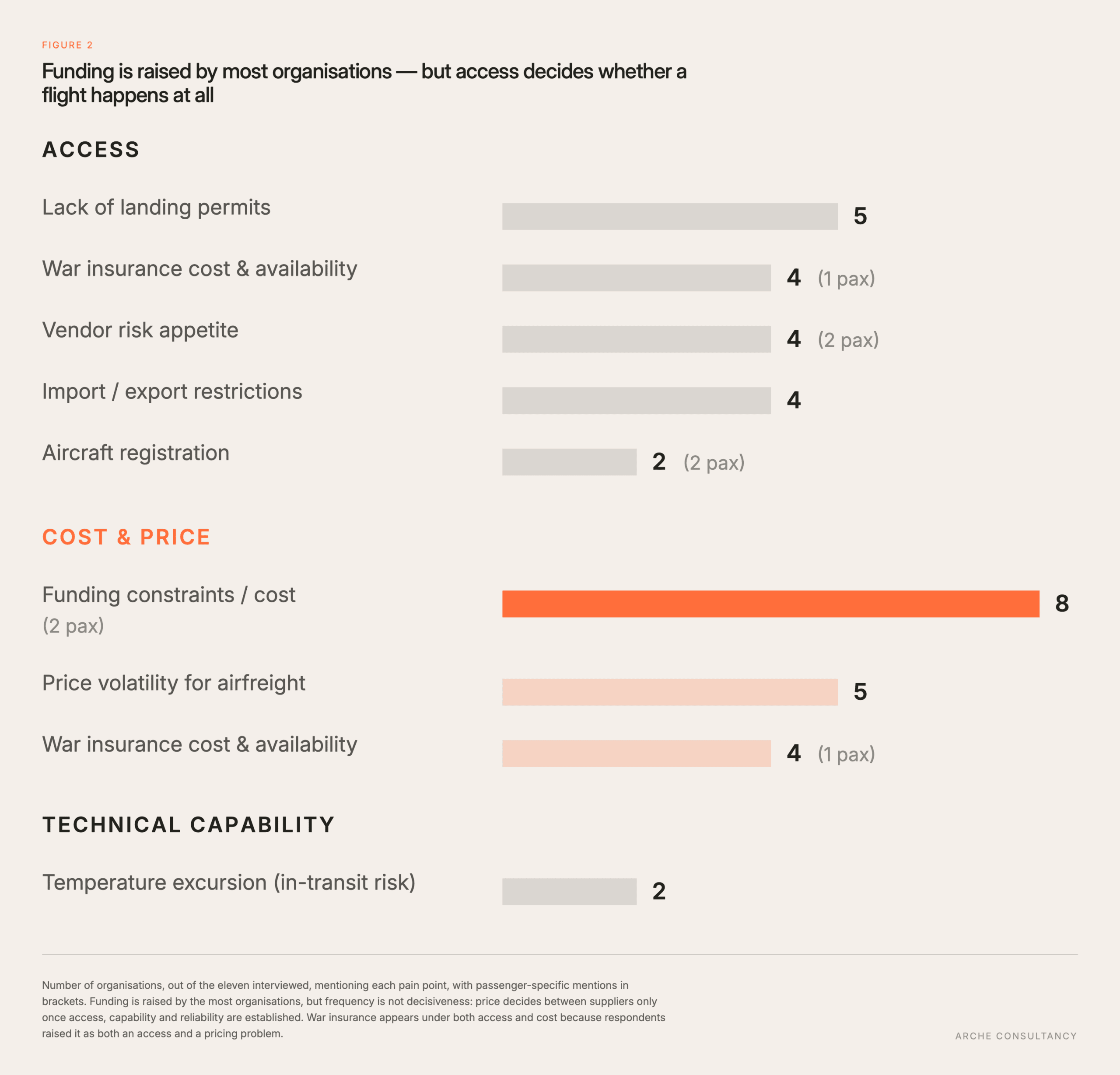
The pain points reported by respondents cluster into three broad themes: access, cost, and supplier technical capability. Figure 2 shows how often each was raised.
Access
More broadly, humanitarians expect their suppliers, whether for passenger or for cargo, to share the organisation’s risk profile by building the internal capability to fly where few can or want to, owing to risks of war or natural hazard. Finally, NGOs frequently report the difficulty of obtaining the required import permits at destination as one of the main pain points they need to solve.
Cost
Supplier Technical Capability
Drones: still at an exploratory phase
What struck me most in the desk review was how much has been written about drones for humanitarian operations relative to how little is happening in practice. Below are the main barriers of adoption as reported.
Barriers of adoption:
Perceived dual use
Drones risk being mistaken for military aircraft, which would compromise humanitarian neutrality as a key principle.
Regulatory and operational complexity
A pre-positioned drone itself counts as dangerous goods, and operating one requires licensing and expertise that organisations do not always have in-house, least of all in a last-mile environment.
A stalemate over who moves first
Humanitarian organisations want vendors to prove the model works, while vendors want organisations to commit funding first, in order to develop humanitarian-type prototypes.
For humanitarian organisations, drones remain at an experimental stage for now.
What would it take for the sector to rethink the purchase of air transport?
Most organisations purchase independently, and in fact mostly from the same four or five major global freight forwarders. Not only does the sector fragment its demand, it also approaches it through different purchasing strategies: spot, long-term agreement, or outsourcing to suppliers in the case of small NGOs.
It’s surely time to rethink how Humanitarian air transport is being purchased.
About Arche
Arche is a boutique consultancy working at the intersection of the private and humanitarian sectors.